

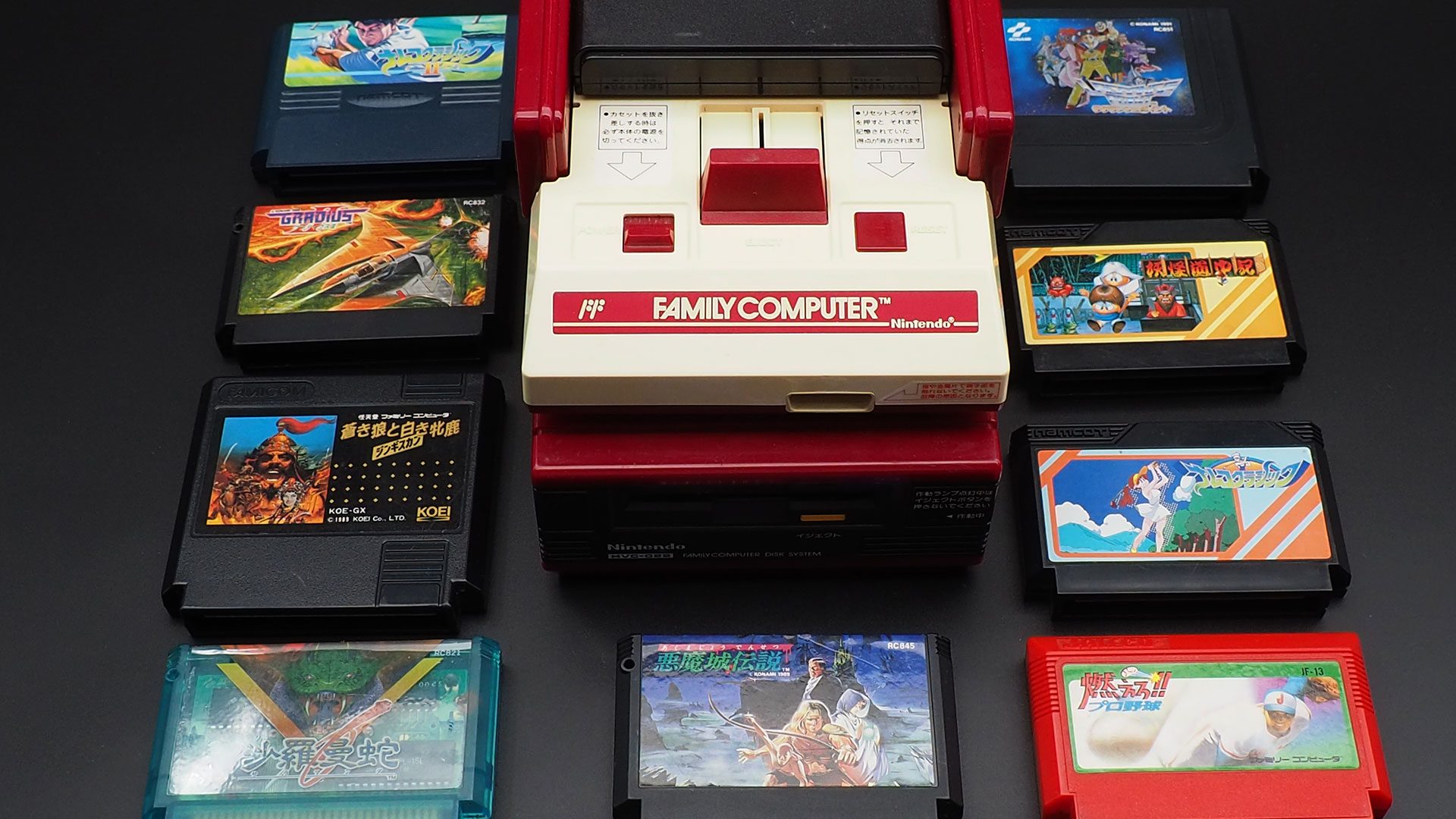
In addition to the sound hardware built into the Famicom itself, some games used special chips installed inside their cartridges to enhance the system’s audio capabilities.
These chips were not necessarily designed exclusively for sound. Nevertheless, support for them can serve as a useful benchmark when determining whether a Famicom-compatible console can reproduce a game correctly.
Expansion audio has also received renewed attention in recent years thanks to the growing popularity of chiptune music, which makes use of the distinctive sounds produced by classic game hardware.
This made me curious about the different types of Famicom expansion audio chips and which games actually used them, so I decided to investigate. I have omitted detailed explanations of the technical characteristics of each chip, as some of those details remain unclear to me.
Most of the basic information in this article is based on the NES Cart Database.
Please note that although Aoki Ookami to Shiroki Mejika: Genghis Khan appears in the photograph, I purchased it by mistake. Sorry about that!
MMC5 — Multi-Memory Controller 5
Manufacturer: Nintendo
MMC stands for Multi-Memory Controller, a series of special chips designed to expand the capabilities of the Famicom.
Nintendo produced several versions, ranging from MMC1 to MMC6. The MMC5 appears to have been used particularly often in games published by Koei.
Cartridges containing the MMC5 are generally larger than standard Famicom cartridges, making them relatively easy to spot in secondhand game shops.
Compatible cartridges
- Aoki Ookami to Shiroki Mejika: Genchou Hishi
- Daikoukai Jidai — Uncharted Waters
- Gun Sight — expansion audio effect could not be confirmed
- Ishin no Arashi
- Just Breed
- L’Empereur
- Metal Slader Glory — may not use the chip for audio
- Nobunaga no Yabou: Bushou Fuuunroku — expansion audio effect could not be confirmed
- Nobunaga no Yabou: Sengoku Gunyuuden
- Royal Blood
- Sangokushi II — expansion audio effect could not be confirmed
- Shin 4-Nin Uchi Mahjong: Yakuman Tengoku
- Suikoden: Tenmei no Chikai
- Uchuu Keibitai SDF — used for sound effects
NAMCOT-160/N160 and NAMCOT-163/N163
Manufacturer: Namco
These Namco expansion chips were used primarily in Japanese Famicom games.
They were somewhat more advanced than Nintendo’s MMC3, and several variations reportedly existed, ranging from the N160 to the N163.
The chip is also frequently referred to as the N106. However, this name apparently originated from a mistaken reading or transcription of “N160” that later became widespread.
Digital Devil Story: Megami Tensei II is sometimes described as using the N160, but the NES Cart Database classifies it as an N163 game.
Unfortunately, the chip inside the actual cartridge is covered in black resin, making it impossible to identify visually.

Compatible cartridges
- Battle Fleet
- Dokuganryuu Masamune
- Dragon Ninja
- Erika to Satoru no Yume Bouken
- Famista ’90 — expansion audio effect could not be confirmed
- Final Lap
- Hydlide 3: Yami kara no Houmonsha
- Juubei Quest
- Kaijuu Monogatari
- King of Kings
- Mappy Kids
- Digital Devil Story: Megami Tensei II
- Mindseeker
- Namco Classic
- Namco Classic II
- Rolling Thunder
- Sangokushi II: Haou no Tairiku
- Sangokushi: Chuugen no Hasha
- Youkai Douchuuki
VRC — Virtual ROM Controller
Manufacturer: Konami
Nintendo maintained strict control over Famicom cartridge hardware and rarely allowed third-party publishers to develop their own printed circuit boards or memory mappers.
As a result, there were relatively few third-party expansion chips for the Famicom. Konami’s VRC, or Virtual ROM Controller, series was one of the notable exceptions.
Several versions were produced, ranging from VRC1 to VRC7. The most significant from an audio perspective are the VRC6 and VRC7.
The VRC6 supports program and graphics bank switching, as well as a CPU cycle-based IRQ counter that can function as a scanline counter. It also provides three additional sound channels.
Like the VRC6, the VRC7 supports bank switching and IRQ counting. It also includes a six-channel FM synthesizer derived from Yamaha’s YM2413 audio technology.
Only one commercially released Famicom game used the VRC7’s FM audio capabilities: Lagrange Point. This makes it the only Famicom cartridge to feature FM synthesis as an expansion sound source.
VRC1 cartridges
- Ganbare Goemon! Karakuri Douchuu
- King Kong 2: Ikari no Megaton Punch
- Moero!! Junior Basket
VRC2 cartridges
- Getsu Fuuma Den
- Konami Wai Wai World
- Contra
- Jarinko Chie: Bakudan Musume no Shiawase Sagashi
- Ganbare Goemon 2
- Ganbare Goemon Gaiden: Kieta Ougon Kiseru
- Dragon Scroll: Yomigaerishi Maryuu
- Ganbare Pennant Race!
- TwinBee 3: Poko Poko Daimaou
VRC3 cartridges
- Salamander
VRC4 cartridges
- Gradius II
- Akumajou Special: Boku Dracula-kun
- Parodius Da!
- Wai Wai World 2: SOS!! Parsley Castle
- Crisis Force
- Ganbare Goemon Gaiden 2: Tenka no Zaihou
- Tiny Toon Adventures
- Bio Miracle Bokutte Upa
- Racer Mini Yonku: Japan Cup
- T.M.N.T. Turtles
VRC5 cartridges and hardware
- Famicom CAI Learning Adapter Q-ta
VRC6 cartridges
- Akumajou Densetsu — the Japanese version of Castlevania III: Dracula’s Curse
- Mouryou Senki MADARA
- Esper Dream 2: Aratanaru Tatakai
VRC7 cartridges
- Lagrange Point — the only Famicom cartridge to use FM synthesis for its music
- Tiny Toon Adventures 2: Montana Land e Youkoso — the audio hardware may not be used
SUNSOFT 5B
Manufacturer: Sunsoft
The SUNSOFT 5B is an expansion chip found in Gimmick!, a rare Famicom game that frequently sells for high prices on the secondhand market.
The chip reportedly includes sound hardware comparable to the Yamaha YM2149, which was widely used as a programmable sound generator, or PSG.
Compatible cartridges
- Gimmick!
uPD7756C/D7756C
Manufacturer: NEC
The uPD7756C is a speech and sound-sample playback chip.
It was used to reproduce voices and sound effects during gameplay, including the famous “Play ball!” voice sample heard in Moero!! Pro Yakyuu.
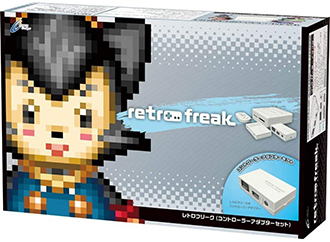
Game-ripping systems such as the Retro Freak and multicarts such as the EverDrive may be able to run these games while still failing to reproduce the additional voice samples correctly.
Compatible cartridges
- Moero!! Pro Yakyuu
- Moero!! Pro Yakyuu ’88 Ketteiban
- Moero Pro! ’90 Kandouhen
- Moero Pro! Saikyouhen
- Shin Moero!! Pro Yakyuu
- Moero!! Pro Tennis
With the exception of the original Moero!! Pro Yakyuu, the additional voice playback in these games has not been personally verified.
Famicom Disk System Expansion Audio — RP2C33
Manufacturer: Nintendo
The Famicom Disk System’s expansion sound hardware is built into the system’s RAM Adapter.
It was designed to enhance the Famicom’s audio capabilities and supports a form of frequency modulation, allowing composers to create sounds with a character that differs considerably from the console’s standard audio channels.
Compatible games
The expansion audio is used in a variety of Famicom Disk System titles, including The Legend of Zelda.
![[Review] Roguecraft GB Is a Fantastic Pure-Fantasy Roguelike for the Game Boy Color](https://retro-gamer.jp/sub/wp-content/uploads/2026/08/20260210_212849.MOV_000000816-150x150.jpg)




 PCエンジン mini
 HYPERKIN SUPABOY HYPER BEACH
 メガドライブミニ
 【懐かしいゲームボーイを大画面でプレイ】Hyperkin RetroN Sq: HD Gaming Console (カラー:ハイパービーチ/Hyper Beach) For Game Boy®/Game Boy Color®/Game Boy Advance® [432428]
 レトロフリーク (レトロゲーム互換機) (コントローラーアダプターセット) コントローラー+1個 ( SFCカラー )
 ドクターペッパー クラブマルチ 350ml缶×10缶
コメントを残す